Grammatical materials in late Byzantine miscellaneous manuscripts

After his studies in Saint Petersburg, Florence, and Münster, Grigory Vorobyev got a PhD in Greek and Latin paleography from Sapienza University of Rome and a C.Sc. degree in Classical, Byzantine, and Neo-Hellenic philology from the University of Saint Petersburg. He worked then at the Russian Academy of Sciences, where he explored the early modern reception of Aristotle’s scientific vocabulary and cataloged Greek manuscripts. Grigory taught Greek and Latin at HSE University Saint Petersburg, as well as Greek and Latin paleography at the University of Tartu.
After research stays at the Ludwig Boltzmann Institute for Neo-Latin studies, at the University of Innsbruck, and at the Aristoteles-Archiv of the FU Berlin, he is now joining MELA as a paleographer. In Ghent, Grigory will be investigating late Byzantine miscellaneous manuscripts transmitting grammatical textbooks and related materials. Alongside conventional codicological description and Provenienzforschung, particular attention will be paid to the detection of linguistically relevant metadata of marginalia and other paratextual elements.
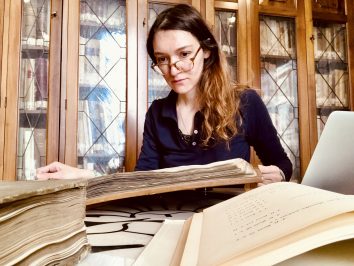 Dr. Elisa Bianchi got her MA in Byzantine Philology from the Catholic University – Milan in 2011. She pursued her PhD in Greek Paleography at the University of Rome La Sapienza (2015) with a thesis focused on the Fettaugen-Mode and the graphic framework of the second half of the 13th century. In the most recent years, she participated in numerous cataloging projects on Greek manuscripts in various historical libraries in northern Italy. Furthermore, as part of a post-doctoral research project at the University of Bologna (2020-2021, and 2021-2022), she studied manuscript production in Venetian and Bolognese 16th century. From January 2023, she will be a postdoctoral researcher at the Warburg Institute, School of Advanced Study of the University of London as part of the AHRC-funded project “Greek manuscripts in Renaissance Venice: the library of Guillaume Pellicier and its contribution to Europe’s intellectual heritage”.
 From Schools to Practice. The language of the epistolary of Demetrios Kydones